
Equipment · September 16, 2026
Hard Water Doesn’t Make Your Tap Unsafe. It Can Still Wreck the Heat Exchanger — and the Payback.
Hard water is not a potability scandal. It can still wreck a heat exchanger and the payback. California’s AB 1366 brine rules sit on top of that.
14 minute read · Bruce Cheney / Anchors Aweigh Energy
Hard water is not a potability scandal. The U.S. EPA does not set a Primary MCL or Secondary SMCL for hardness. The WHO does not propose a health-based guideline value for hardness at levels found in drinking water. California drinking-water rules do not ban hardness either.
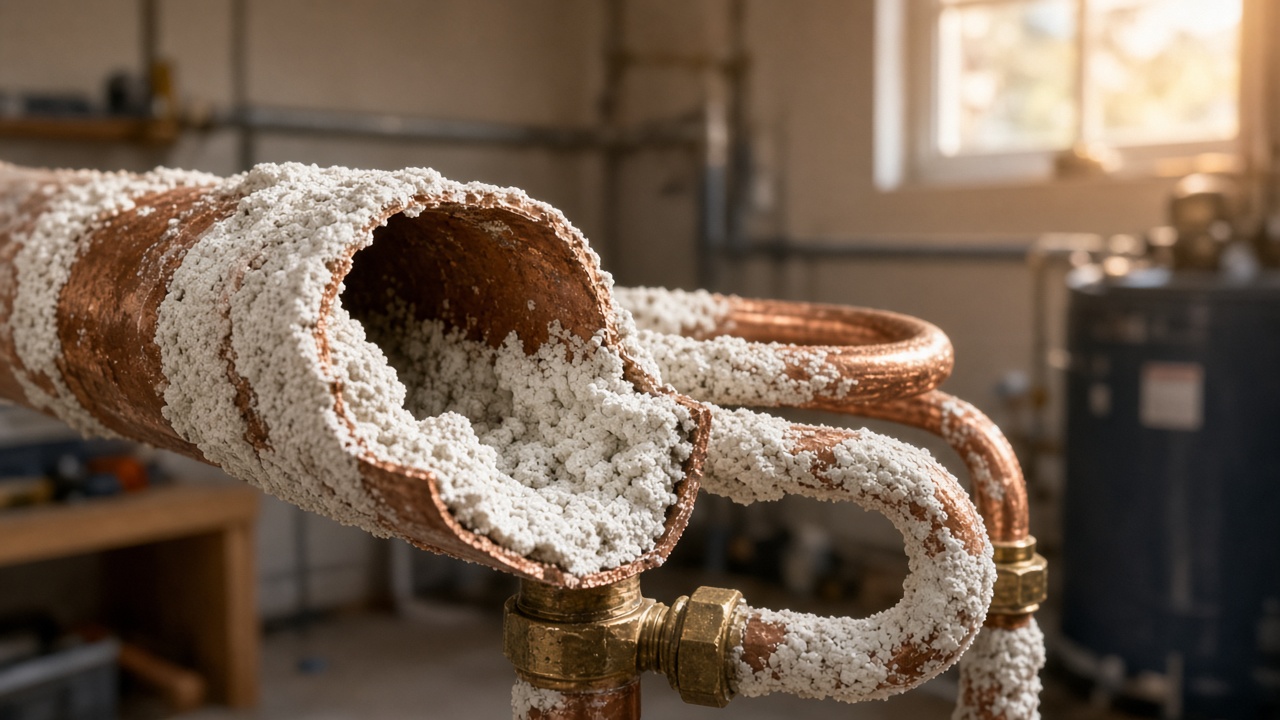
What hard water does do is deposit calcium and magnesium scale on every hot surface that relies on a clean heat exchanger: tankless coils, storage tanks, heat pump water heater condensers on the water side, dishwashers, and fixtures. That is an equipment, efficiency, warranty, and payback problem — especially in San Diego County, where the Statewide CASE Team’s water-heating work already flagged local hardness as among the hardest in the state.
This is not legal advice and not a substitute for your manufacturer’s warranty or your water utility’s Consumer Confidence Report. Read the rating plate and the warranty PDF before you buy.
What “hard” actually means
Hardness is mostly dissolved calcium and magnesium, usually reported as mg/L (ppm) as CaCO₃. Grains per gallon (gpg) are the trade shorthand: roughly 1 gpg ≈ 17.1 mg/L as CaCO₃.
USGS descriptive bands (mg/L as CaCO₃):
| Classification | mg/L as CaCO₃ | ≈ gpg |
|---|---|---|
| Soft | 0–60 | 0–3.5 |
| Moderately hard | 61–120 | 3.5–7 |
| Hard | 121–180 | 7–10.5 |
| Very hard | >180 | >10.5 |
WHO’s background document uses a similar descriptive ladder (<60 / 60–120 / 120–180 / >180 mg/L). Those are labels, not drinking-water MCLs.
San Diego context (CASE narrative, not a Battelle lab measurement): the 2016 Residential Instantaneous Water Heaters CASE Addendum (CEC TN 74391) notes that San Diego is about 15 gpg and Anaheim about 18 gpg, and calls both among the hardest waters in California. Fifteen gpg is roughly 257 mg/L as CaCO₃ — very hard on the USGS scale. Your exact street can differ; check your utility CCR or a hardness test.
Potability vs scale — what the standard-setters actually say
| Body | Hardness and drinking water | What that means for this article |
|---|---|---|
| EPA (SDWA) | No Primary MCL; no hardness SMCL. TDS SMCL (500 mg/L) lists “hardness; deposits” as a noticeable effect of high TDS, not a hardness limit. | Hard water can still be potable. Softening is not an SDWA Primary compliance tool. |
| WHO GDWQ | No health-based guideline value; “not of health concern at levels found in drinking-water”; may affect acceptability. | Softening is aesthetic/operational, not “safer to drink.” |
| CDC | Softeners remove Ca/Mg; hard water → scale and poor lather; softeners do not remove parasites, bacteria, or viruses. | Softeners are not disinfection. |
| USGS | Hardness classification bands (above). | Use for “soft / hard / very hard” language. |
| NSF/ANSI 44 | Certifies residential cation-exchange softener performance (capacity, salt efficiency, etc.). | Certification ≠ health claim that soft water is more potable. |
| AWWA | Practice/guidance for utilities; not a residential hardness MCL. | Do not invent an AWWA “homeowner hardness limit.” |
| WQA | Industry association; sponsored the Battelle 2010 study cited below. | Disclose sponsorship when citing Battelle. |
| CA SWRCB / Title 22 | No hardness MCL found as a statewide drinking-water maximum in this review. | Same potability frame as EPA. |
| CA HSC §§116775–116795 | Demand-initiated regeneration; ≥4,000 grains/lb salt efficiency (post-1/1/2002 installs); fixture conservation; outdoor hose-bib exceptions. | Floor rules for how a sewer-discharging softener may be installed. |
| CA Water Code §13148 (AB 1366, 2009) | Locals in listed regions (incl. South Coast / San Diego) may restrict or ban residential self-regenerating brine softeners after a regional-board salinity finding. Portable exchange tanks stay allowed. | Salinity / recycled-water control — not a claim that salt softeners “don’t work.” |
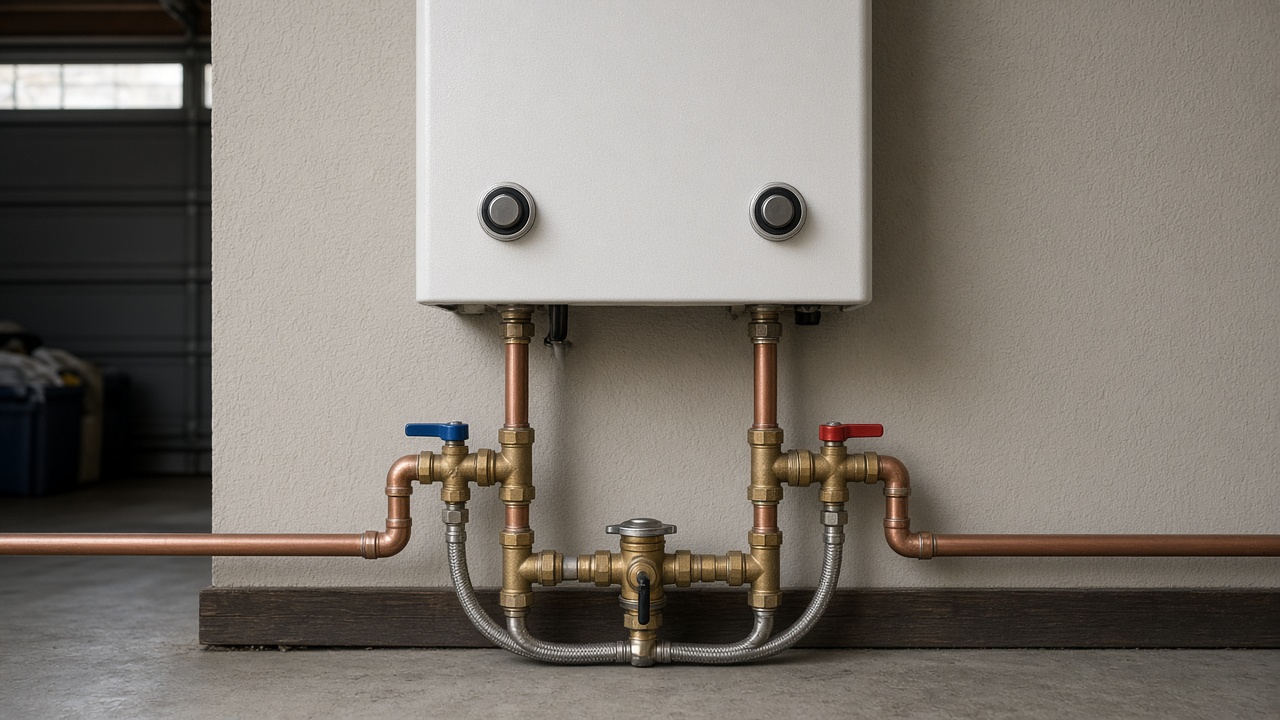
| Title 24 Part 6 §110.3(c)6 | Isolation valves / hose bibbs on instantaneous water heaters >6.8 kBtu/h so you can flush scale. | Code forces maintainability, not softening. |
| ASME / ASHRAE | No domestic drinking-water hardness MCL found for this article. | Out of scope for potability claims. |
Sodium caveat (EPA Drinking Water Advisory, not an MCL): ion-exchange softeners add sodium. EPA’s advisory discusses taste (about 30–60 mg/L) and a 20 mg/L guidance level for people on highly restricted sodium diets. WHO notes household softeners increase sodium and suggests softening hot water only and/or a kitchen cold-water bypass when diet matters.
What the CEC CASE record actually proved about scale
For the 2016 Title 24 residential instantaneous water heater measure, the Statewide CASE Team leaned on Battelle Memorial Institute (Paul et al.), 2010, Study on Benefits of Removal of Water Hardness…, prepared for the Water Quality Association.
Test waters (Battelle): unsoftened well water at 26.2 gpg; softened at <0.55 gpg.
The line that should be on every San Diego change-out bid (quoted in CEC TN 74391):
“none of the electric or gas storage water heaters or the instantaneous gas water heaters on the un-softened water made it through the entire testing period because the outlet piping system consisting of one-half inch copper pipe, a needle valve, and a solenoid valve became clogged with scale buildup.”
That is not a rumor from a softener salesman. It is in the CEC-filed CASE addendum that helped justify mandatory isolation valves so field crews can flush tankless heat exchangers.
Efficiency hits from the same CASE / Battelle chain (equivalent years of service):
| Equipment | Soft / managed path | Unsoftened hard-water path |
|---|---|---|
| Gas instantaneous | Flush restores performance after descaling (CASE: after flush, example unit returned toward ~77%) | 80% → 72% over ~1.6 equivalent years, then controls failed until flushed |
| Gas storage | Scale still forms; CASE notes fewer recovery options than tankless flushing | ~70% → 67% over ~2 equivalent years (~3 point drop) |
CASE flush-interval projections (Battelle extrapolation, 50 gallons/day hot water): roughly ~2 years between flushes at >20 gpg, ~4 years at >10 gpg, ~8 years in soft water. Plumber interviews in the CASE tracked a similar hard-water cadence (about every 2 years in hard water; 3–4 years in soft).
PNNL’s water-quality report on the CEC docket (TN 74278) summarizes the same Battelle work and notes scale can cut equipment life on the order of 25–40% in cited extreme cases (via Konigsberg 2011 as filed in that report). Use that as a life-risk band, not a promise for your street.
Warranty: the fine print that scale owns
Manufacturers do not warranty the geology of San Diego.
Typical tankless / Rheem-class language (public Rheem limited-warranty certificates): coverage exclusions for damages, malfunctions, or failures caused by lime, mineral build-up, or scale, and for failure to operate/maintain within manufacturer water-quality instructions.
Example HPWH / CO₂ heat-pump water heating manual language (Eco2 / SANCO₂ GS4 family, water-quality section): where chloride exceeds 200 mg/L or water hardness exceeds 200 mg/L (~11.7 gpg), warranty does not apply to the heat pump and tank; pH outside the stated band likewise voids coverage. Separate exclusion: repair/replacement due to scale formation above 200 ppm (water hardness).
Two practical points for buyers:
- San Diego CASE hardness (~15 gpg / ~257 mg/L) sits above a 200 mg/L hardness warranty ceiling of that type. Softened water in the Battelle soft leg (<0.55 gpg) does not.
- A softener does not automatically “create” a warranty — but documented water quality inside the manufacturer’s published limits, plus flush records where required, is what claims adjusters ask for when a heat exchanger leaks.
Read your model’s warranty and install manual. Brands differ. The pattern does not: scale is your problem.
Cost–benefit: San Diego–hard vs design-soft (10-year sketch)
Assumptions are labeled. Dollars are order-of-magnitude San Diego market ranges for planning, not a quote. Energy rates, salt prices, and plumber rates move.
Columns
- Design-soft home: hardness in the soft / Battelle-softened neighborhood (about <3.5 gpg, ideally near the <0.55 gpg test leg). Equipment sees water closer to what lab ratings and many warranty water-quality tables assume.
- San Diego–hard, untreated: about 15 gpg (CASE narrative). Very hard on USGS banding.
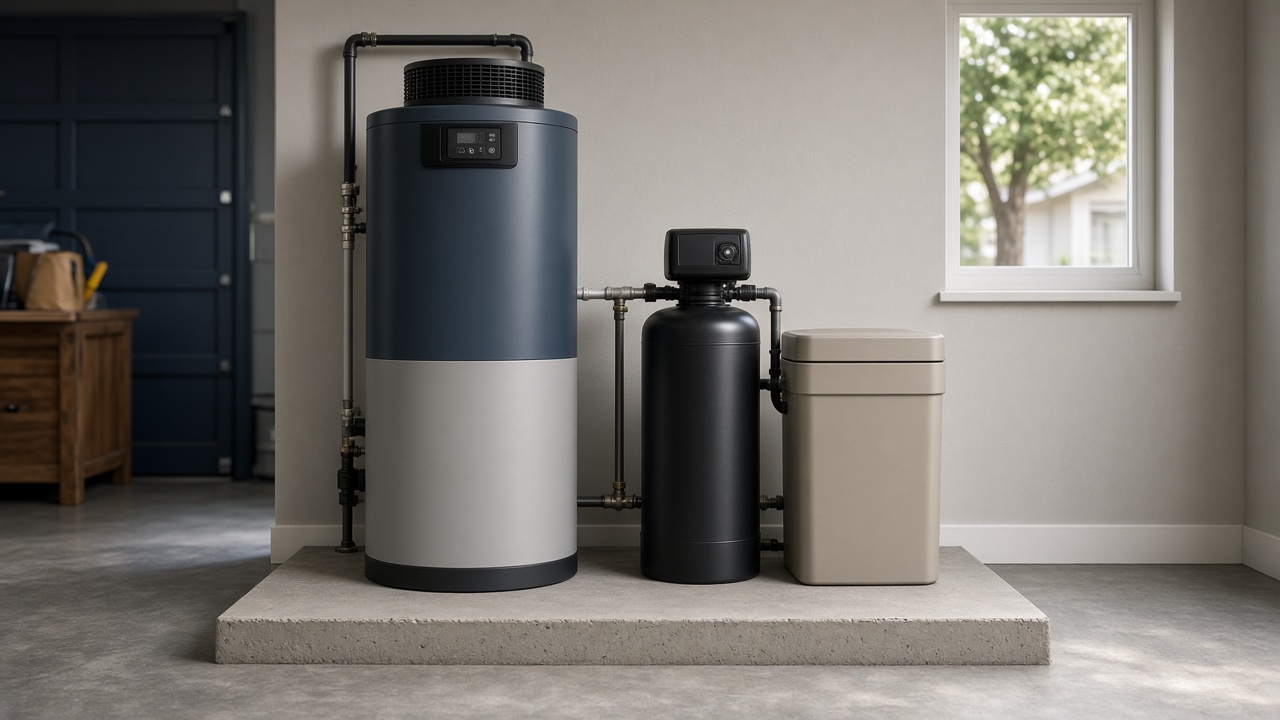
- San Diego–hard + softener: same street water, ion-exchange softener upstream of the water heater (and usually the whole house), with kitchen cold bypass if diet requires it.
Illustrative 10-year ownership sketch for a heat-exchanger water heater (tankless or HPWH water-side):
| Cost / risk item | Design-soft home | San Diego–hard, untreated | San Diego–hard + softener |
|---|---|---|---|
| Whole-house softener install (market range) | $0 | $0 | ~$1,200–$4,000 installed (San Diego residential ranges published by cost guides / local plumbing estimators, 2025–2026) |
| Softener salt & upkeep (10 yr) | $0 | $0 | ~$400–$1,500 (salt + occasional media/service; household size dependent) |
| Descale / flush visits (CASE cadence × SD market) | ~1–2 visits over 10 yr (~8 yr soft interval) | ~3–5 visits over 10 yr (15 gpg sits between CASE “>10” and “>20” bands; many local contractors push annual tankless descaling in SD) | ~1–2 visits if softener keeps hardness inside manufacturer limits |
| Flush / descale spend (10 yr) | ~$150–$600 | ~$450–$1,500+ (using ~$150–$300 per professional tankless descale as a common marketed band; confirm locally) | ~$150–$600 |
| Rated efficiency you actually keep | Near nameplate if maintained | CASE/Battelle: tankless example ~10% relative drop (80→72) before failure-to-flush; storage ~3 points over ~2 equivalent years — ongoing until descaled or replaced | Closer to nameplate if hardness stays in-spec |
| Warranty posture on lime/scale failure | Stronger if water meets manual | Weak — scale exclusions; some manuals hard-cap ~200 mg/L hardness | Stronger if hardness/pH stay inside the published envelope and you keep records |
| Early replacement risk | Baseline | Elevated (CASE clogged-path test; PNNL life-cut citations 25–40% in extreme untreated cases) | Closer to baseline |
| Rough 10-yr extra vs soft baseline | — | Hundreds to low thousands in flushes + efficiency waste + risk of a four-figure heat-exchanger or tank replacement outside warranty | Softener capex + salt, usually less volatile than repeated failures |
How this changes payback
Utility rebates and Title 24 compliance credit assume the machine delivers something close to its rated efficiency for its rated life. Scale attacks both legs of that deal:
- Efficiency decay — you buy a high-UEF / high-COP story and operate a partially insulated heat exchanger.
- Life / warranty decay — the year the coil or tank fails early, the NPV of the “efficient” choice collapses, especially if the claim is denied for mineral damage.
- Maintenance tax — San Diego’s hardness moves you from rare flushes to a standing service line item. Isolation valves (Title 24 §110.3(c)6 on qualifying tankless) make that service possible; they do not make it free.
A softener does not appear in the CF1R as a magic Title 24 credit. It shows up in the real payback spreadsheet: fewer emergency truck rolls, fewer “out of hot water” callbacks, and a warranty file that still has a chance.
California’s 2009 salt-softener rules (AB 1366) — and why they matter
Salt-based cation-exchange softeners (self-regenerating units that regenerate with sodium chloride or potassium chloride) are still the residential technology that actually removes hardness grains — Ca²⁺ and Mg²⁺ leave the water. “Salt-free” conditioners and template media may reduce scale stickiness in some installs; they do not turn 15 gpg San Diego water into soft water the way Battelle’s soft test leg did. If your warranty and heat-exchanger payback depend on grains removed, that is the distinction that matters.
California did not ban that technology statewide. What it did do is tighten when and how brine can hit the sewer — because every regeneration dumps salt load into community sewers and recycled-water programs.
Health and Safety Code §§116775–116795 already set the statewide floor for residential softeners that discharge to a community sewer:
- Regeneration must be demand-initiated (not a dumb timer dumping brine on a clock), and
- Units installed on or after Jan 1, 2002 must be third-party certified at ≥4,000 grains of hardness removed per pound of salt (the earlier floor was 3,350 grains/lb for installs on or after Jan 1, 2000).
AB 1366 (Feuer), Chapter 527, Statutes of 2009, effective Jan 1, 2010, added Water Code §13148. In listed hydrologic regions — including the South Coast (San Diego County is in that map) — a local agency that owns a community sewer system or water recycling facility may, after a regional board finding that controlling residential salinity will help meet water-quality objectives, adopt an ordinance or resolution to:
- prohibit new residential self-regenerating softeners that discharge brine to the sewer,
- require removal or replacement of existing units (with compensation rules when removal is forced),
- force higher efficiency / hot-water-only hookups / permits / buy-back programs, and related controls.
*What AB 1366 does not ban: portable exchange* (tank-swap) softeners. Those regenerate off-site; the statute expressly leaves them available even where a city or district restricts on-site brine discharge.
Practical San Diego takeaway: check your sewer / recycled-water agency before you hang a brine-discharging softener next to a new tankless or HPWH. Where on-site salt units are restricted, portable exchange or a documented flush-and-maintain plan is the compliance path — not a “salt-free” gadget that leaves hardness grains in the water. The physics problem (scale on the exchanger) does not go away because the salinity ordinance does.
What California code actually requires (and does not)
Requires (Energy Code): isolation valves / flush fittings on qualifying instantaneous water heaters — §110.3(c)6 (current numbering). That came out of the same CASE conversation about hard-water maintenance.
Requires (Plumbing / HSC when you install a softener that discharges to the community sewer): demand-initiated regeneration, the ≥4,000 grains/lb salt-efficiency floor for post-1/1/2002 installs (HSC §§116775–116795), sizing (CPC softener tables), outdoor hose-bib exceptions, and whatever your local sewer / recycled-water agency allows under Water Code §13148 (AB 1366).
Does not require: a statewide mandate to soften above X gpg before you may install a water heater. Manufacturers and physics still collect. AB 1366 is local salinity control, not a statewide softener ban.
Title 24 / HERS/ECC still apply to the water-heater compliance path (HPWH readiness, CF1Rs, field verification where required). Softening is parallel risk management, not a substitute for the Energy Code.
What we tell San Diego owners and contractors
- Test hardness (utility CCR + a field strip or lab). Write the gpg on the job ticket.
- Read the warranty water-quality table before you hang a tankless or HPWH. If the manual says 200 mg/L hardness max, San Diego untreated water is not a paperwork problem — it is a claim denial waiting for a leak.
- Budget real hardness removal or a documented flush plan the same day you budget the water heater — and confirm your sewer agency still allows a brine-discharging softener under AB 1366 / Water Code §13148. Softener-first (or portable exchange where on-site brine is banned) is usually cheaper than exchanger-second. Do not confuse salt-free “conditioners” with grain removal.
- Install isolation valves on tankless (code on qualifying units) and keep flush receipts.
- Do not tell people hard water is unsafe to drink because it is hard. Tell them the truth: it is hard on equipment.
We write Title 24 and we test systems. We do not sell softeners. If your change-out just grew a water-quality argument at the counter, put us on the call so the CF1R and the mechanical reality match.
Call 858-254-1189.
— Bruce Cheney, Anchors Aweigh Energy
Primary sources (editors)
- EPA Secondary Standards / SDWA NPDWR pages; EPA Sodium Drinking Water Advisory (2003)
- WHO GDWQ hardness fact sheet & 2011 hardness background document
- CDC home water treatment overview
- USGS water hardness classification
- NSF/ANSI 44 (softener performance certification scope)
- CA HSC §§116775–116795; Water Code §13148 (AB 1366 / Stats. 2009, Ch. 527); Title 24 Part 6 §110.3(c)6
- CEC CASE Addendum TN 74391 (and related TN 74377 / 74627 / 75515); Battelle / Paul et al. 2010 (WQA-sponsored); PNNL-22921 TN 74278
- Manufacturer warranties/manuals: Rheem limited-warranty scale exclusions; Eco2/SANCO₂ GS4 water-quality & scale exclusions (200 mg/L hardness)
- San Diego softener install cost bands: published 2025–2026 residential cost guides / local plumbing estimators (ranges, not bids)