
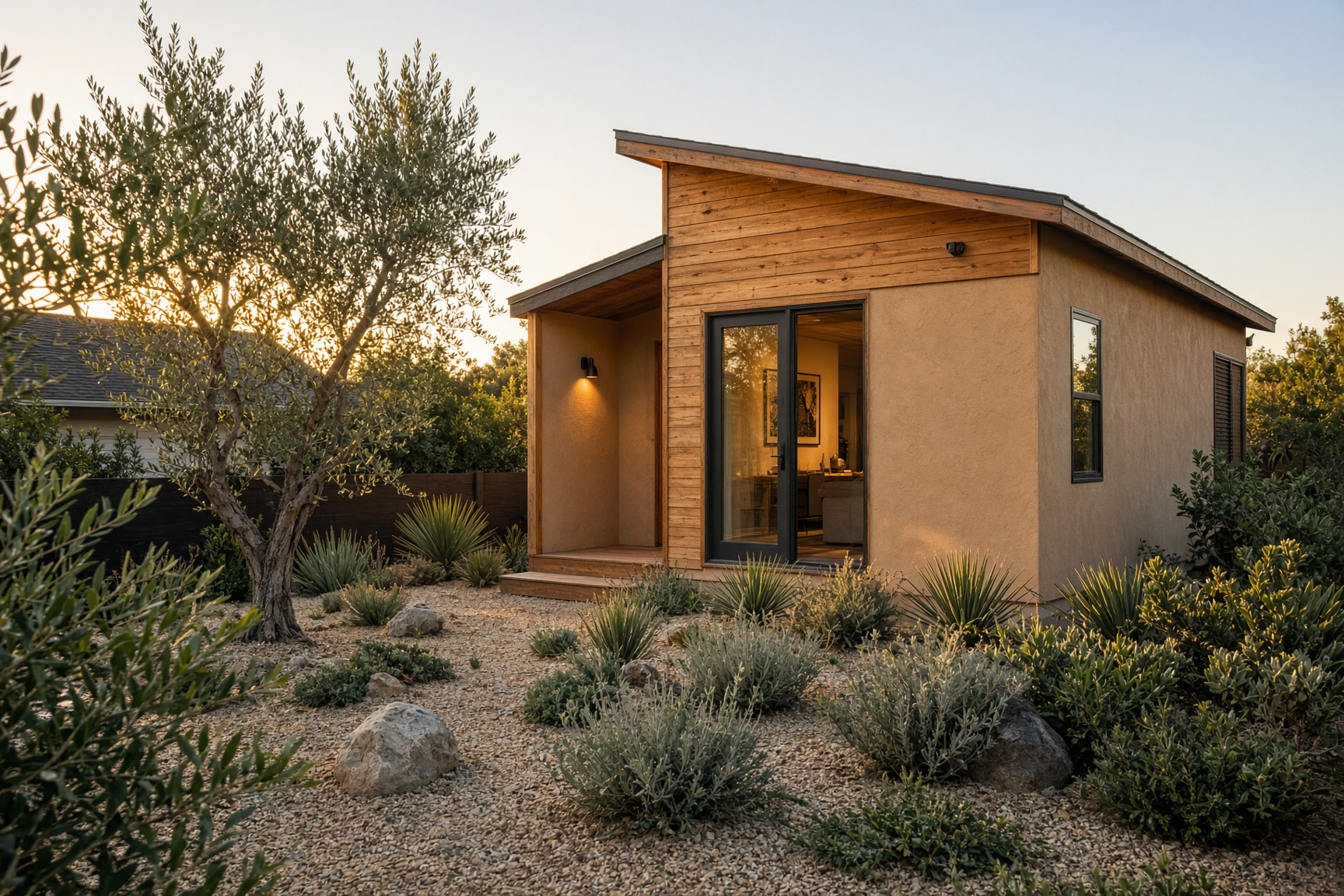
Permit application date, not construction date, picks the code. For applications filed on or after January 1, 2026, that is the 2025 Title 24 Part 6 Energy Code and 2025 CalGreen. This page is a field guide, not a CF1R.
Which path you are on
2025 Energy Code / CEC ADU FAQs. Classification is by newly constructed building, addition, or alteration — not by the planning label. Planning “detached” is not Energy Code “new construction.” A detached garage conversion is still an addition.
| What you are building | Energy Code class | Solar PV (prescriptive) |
|---|---|---|
| New detached ADU, never occupied (including attached only by a breezeway) | Newly constructed | Yes, unless an exception (see solar) |
| New attached ADU sharing a wall, floor, or ceiling | Addition | No |
| Garage / barn / unconditioned space converted (attached or detached) | Addition | No |
| Already-conditioned space converted (bedroom, basement, JADU in the house) | Alteration | No |
| JADU | Addition or alteration. City of San Diego: JADUs are not required to provide PV | No |
| HUD-labeled manufactured home | Not Title 24 Part 6 | No Part 6 PV |
| Factory-built (HCD) housing | Title 24 including Part 6 | Same as site-built of that type |
Solar — the folklore vs the code
- “ADUs are exempt from solar” is false as a blanket rule.
- “All detached ADUs need solar” is also false. Conversions are additions. New detached ADUs skip PV if Exception 2 applies (required size under 1.8 kWdc) or SARA is too small.
- Existing house panels do not count. Newly installed modules on the ADU or the primary house, same lot, can. The Energy Code does not require those modules to serve the ADU meter. The utility still has interconnection rules. San Marcos and Escondido have been reported as not accepting an existing array as counting — always confirm with that city.
- Solar-ready roof zones (§110.10) do not apply to a backyard ADU on an existing lot. That rule is for subdivisions of ten or more.
San Diego is mostly Climate Zone 7 (coast) and Climate Zone 10 (inland). In CZ 7, most new detached ADUs around 1,100 sf or less fall under the 1.8 kWdc exception. In CZ 10 the cutoff is around 620 sf. Always run Equation 150.1-C. These square-foot numbers are rules of thumb, not a substitute for the CF1R.
City of San Diego Information Bulletin 400 restates this: newly constructed, non-manufactured, detached ADUs are subject to PV; conversions and additions are not; JADUs are not.
Heat, water, air
- New construction prescriptive path: heat-pump space heat and a 240V heat-pump water heater. Gas is not banned; it is off the prescriptive path and has to pass performance.
- Dwelling units 500 sf or less may use an electric water heater with point-of-use piping (RA4.4.5). One-bedroom or less may use a 120V HPWH.
- Do not extend the main house ducts or share the existing furnace return with the ADU. The ADU needs its own system and thermostat.
- Every new dwelling unit needs whole-dwelling mechanical ventilation, any size. JADUs that are additions to an existing house are the ventilation exception. Kitchen and bath exhaust still apply. Kitchen hoods in units under 750 sf are a common fail.
- Electric-ready and battery-ready (BESS-ready) apply to newly constructed ADUs, not conversions. BESS-ready does not apply if dwelling-unit service is 125 A or less. A battery is not required; being ready is.
What gets field-verified (HERS/ECC)
The 2025 code says Energy Code Compliance (ECC) rater. People still say HERS; we use HERS/ECC. Same job: CF1R at permit, CF2R from the installer, CF3R from the rater, registered with a provider.
Typical new ADU in San Diego: IAQ fan, kitchen hood, QII (additions 700 sf or less are exempt from prescriptive QII), duct leakage if ducted, heat-pump refrigerant charge in all climate zones including CZ 7. Mini-splits still need the tests that apply. City IB-400 requires Title 24 energy calculations on every ADU/JADU submittal.
CalGreen (Part 11)
No general ADU exemption. The ADU-specific exception: EV charging is not required for an ADU or JADU that does not add parking. If you add a parking space, EV-ready can trigger. New fixtures still meet CalGreen flow rates. Construction waste diversion follows local C&D rules (often stricter than the 65% CalGreen floor). CalGreen does not create a separate solar mandate.
San Diego notes
- Permit application date on or after January 1, 2026 = 2025 codes.
- City of San Diego: no Part 6 ADU reach code found; IB-400 is the working document. Coastal ADUs still need the coastal path.
- Unincorporated County: Ord. 10982, effective April 3, 2026, adopts 2025 codes. No ADU energy reach code found. Some County handouts still print “2022” — that is form lag, not the law.
- Federal 30% residential solar credit expired for property placed in service after December 31, 2025. Do not plan on it.
Unpermitted units
Already have an unpermitted ADU?
AB 2533 is a health-and-safety path for unpermitted ADUs and JADUs built before January 1, 2020. It is not automatic legalization and it is not an Energy Code holiday. New work still follows today’s code.
Read AB 2533 for unpermitted ADUsWhat we do
Title 24 CF1R, field verification, and telling you which path you are on before the set hits plan check. Tell us the address and the date you need testing.