Electrical · September 3, 2026
The HVAC GFCI exception expired September 1. California did not delete the rule.
Exception No. 2 to NEC 210.8(F) expired September 1, 2026. California carried that sunset. HARDI’s July 2026 list names sixteen states (NAHB counts 19+). We did not.
9 minute read · Bruce Cheney / Anchors Aweigh Energy
Tuesday was not a rumor. Exception No. 2 to NEC 210.8(F) — the one that said listed HVAC equipment did not need GFCI protection — expired on September 1, 2026. California’s 2025 Electrical Code (Title 24, Part 3, based on the 2023 NEC, in force since January 1, 2026) carried that exception, word for word, with the same sunset. The Building Standards Commission already pointed at that language in Information Bulletin 23-01 when the 2022 code was current. I have not found a later statewide amendment that puts the exception back.
That is the California-specific fact most national write-ups skip. HARDI’s July 2026 list names sixteen states (NAHB counts 19+). California is not on it. Texas is. Georgia is. Virginia is. We are in the bucket that “could require GFCI after the deadline,” and the deadline is behind us.
This is not legal advice and it is not a substitute for the book on your inspector’s desk. Ask the AHJ on the next permit. Then read the rest so you know what you are asking.
What 210.8(F) actually reaches
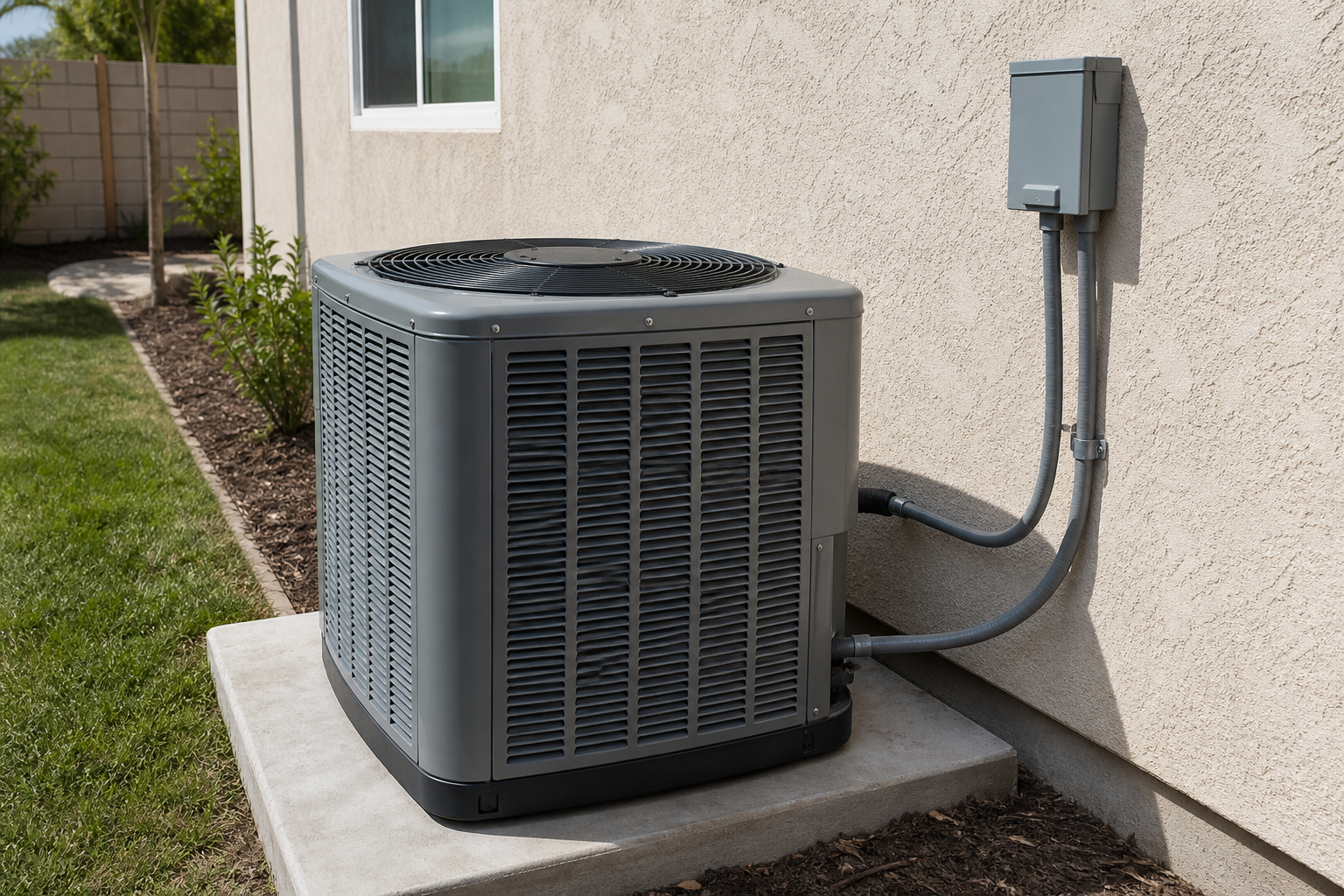
Section 210.8(F) is about outdoor outlets on dwelling units, supplied by single-phase branch circuits rated 150 volts or less to ground and 50 amperes or less. The NEC definition of “outlet” is the point on the wiring system where current is taken to supply utilization equipment. That is why this fight is not only about the 125-volt convenience receptacle within 25 feet of the condensing unit (210.63). It is about the outdoor equipment connection itself — the hard-wired condenser, the heat pump, the mini-split.
Lighting outlets are carved out (except the ones already covered elsewhere). If you replace equipment that is supplied by a covered outlet, the replacement outlet is supposed to have GFCI protection.
Class A GFCI is the personnel device you already know: trips in the 4–6 mA band, listed to UL 943, has to sit somewhere you can actually reset it. An “HF” or “HF+” mark on a Class A breaker is still Class A. It is a high-frequency immunity evaluation, not a different trip class.
Why contractors are angry, and they are not inventing it
Inverter-driven compressors, ECM motors, and variable-speed outdoor units leak high-frequency current to ground as a normal part of how they run. A Class A device can read that as a ground fault and open the circuit. The house loses cooling. The homeowner finds out at 4 p.m. on a 105-degree day. The callback is yours.
AHRI published its 8029 Phase II report in July 2026. One hundred twelve pages. The short version from the people who wrote it: compatibility is not solved. ACCA has said the same thing in public, and they are careful to add that the problem is not only inverter equipment. Texas contractor survey data collected for the 2022 task group already showed nuisance trips on single-stage units too. Five of twelve GFCIs in a later AHRI chart tripped below the must-hold current above 60 Hz — including devices that were supposed to be the high-frequency fix.
Minnesota learned this the hard way in 2021, the first time 210.8(F) was live. Inspectors documented operational trips they could not design away. The only field fix, in more than one report, was the AHJ letting the electrician put a non-GFCI breaker back in so the house had air conditioning. That history is why Exception No. 2 existed, and why AHRI filed Tentative Interim Amendment 1924 to push the sunset to September 1, 2028. Public comment on that TIA closes September 9, 2026. The NFPA Standards Council’s next regular meeting is expected in December. A TIA is not law in California until NFPA issues it and this state, or your city, actually adopts it. Do not bid a job on a TIA that has not been issued.
Cost — the honest version
I will not invent a statewide adder. The cheap compliance path is a two-pole Class A GFCI breaker and a weather-rated disconnect that the inspector will accept. Parts are not the problem. The problem is the second trip, the second truck, the homeowner without cooling, and the panel that will not take the breaker your supply house has in stock.
Class C special-purpose GFCI (SPGFCI, UL 943C) is the device the 2026 NEC added as an HVAC path, with a higher trip band and a required warning label on the disconnect. California is not on the 2026 NEC. We are on the 2023 NEC through the 2025 CEC. Do not assume a Class C device is a legal substitute here unless your AHJ says it is. NAHB and builder groups have also said residential Class C product is thin in distribution, and some HF Class A devices were still moving through the pipeline after September 1.
Budget the conversation, not a made-up dollar. Tell the owner, before you pull the permit: the electrical side of this change-out may include a GFCI breaker the unit has never lived with, and if that breaker nuisance-trips we are looking at a listed HF device, an AHJ conversation, or both. That is the cost that shows up on a Saturday.
Where California contractors stand today
The model-code exception is dead. Unless your city or the State publishes something new, listed outdoor HVAC on a covered dwelling outlet is inside 210.8(F).
Enforcement will not be uniform. Building departments do not all read a sunset the morning after. Some inspectors will want the GFCI on the next condensing-unit permit. Some will wait for a BSC bulletin. Some will grant a field approval if the first breaker chatters. Homepros reported HARDI counting about 24 states in the impact zone and AHRI saying as many as 28 in some form. NFPA itself told them it does not track local amendments. That is your Monday phone call: City of San Diego, the County, Chula Vista, Oceanside, El Cajon — ask each one what they want on the one-line and the disconnect.
Replacement vs. new. 210.8(F) is not only a new-house rule. The replacement sentence is in the 2025 CEC training extract: if the equipment on a covered outlet is replaced, the outlet gets GFCI. A change-out is exactly when this lands on a HERS/ECC job.
Title 24 does not save you. The Energy Code still wants the CF1R, the load calc, and the CF3R tests that apply. GFCI is electrical. The rater does not inspect the breaker class. The electrical inspector does. Get them in the same conversation before the unit is on the pad.
Manufacturer instructions still win fights. If the outdoor unit’s listing or install manual forbids a Class A GFCI, you have a listing conflict, not a debate club. Bring the page. That is how you get an interpretation instead of a failed final.
What we are telling contractors this week
- Call the AHJ on the next residential outdoor change-out. Ask two questions: “Are you enforcing 210.8(F) on listed HVAC as of September 1?” and “If the Class A breaker trips the unit, what will you accept — HF Class A, a variance, or a retest?”
- Do not advertise “GFCI included” as a selling point until you know which device your supply house can actually deliver for that panel family and amperage.
- Keep the 210.63 service receptacle GFCI. That one was already required. Do not confuse it with the equipment circuit.
- Watch TIA 1924 through September 9 and whatever BSC does after. If NFPA issues an extension and California stays silent, you are still on the 2025 CEC text until someone amends it.
- Extreme heat is the life-safety argument on both sides. ACCA has been blunt about it: a silent outdoor unit in a heat wave is not a comfort complaint. Maricopa County’s 2024 indoor heat-death numbers are their citation, not ours, and they are the reason this is not just a parts argument.
We do not install the condenser. We write the Title 24 and we test the system. If your change-out just grew an electrical argument, put us on the call with the inspector so the CF1R and the one-line say the same thing.
Call 858-254-1189.
— Bruce Cheney, Anchors Aweigh Energy